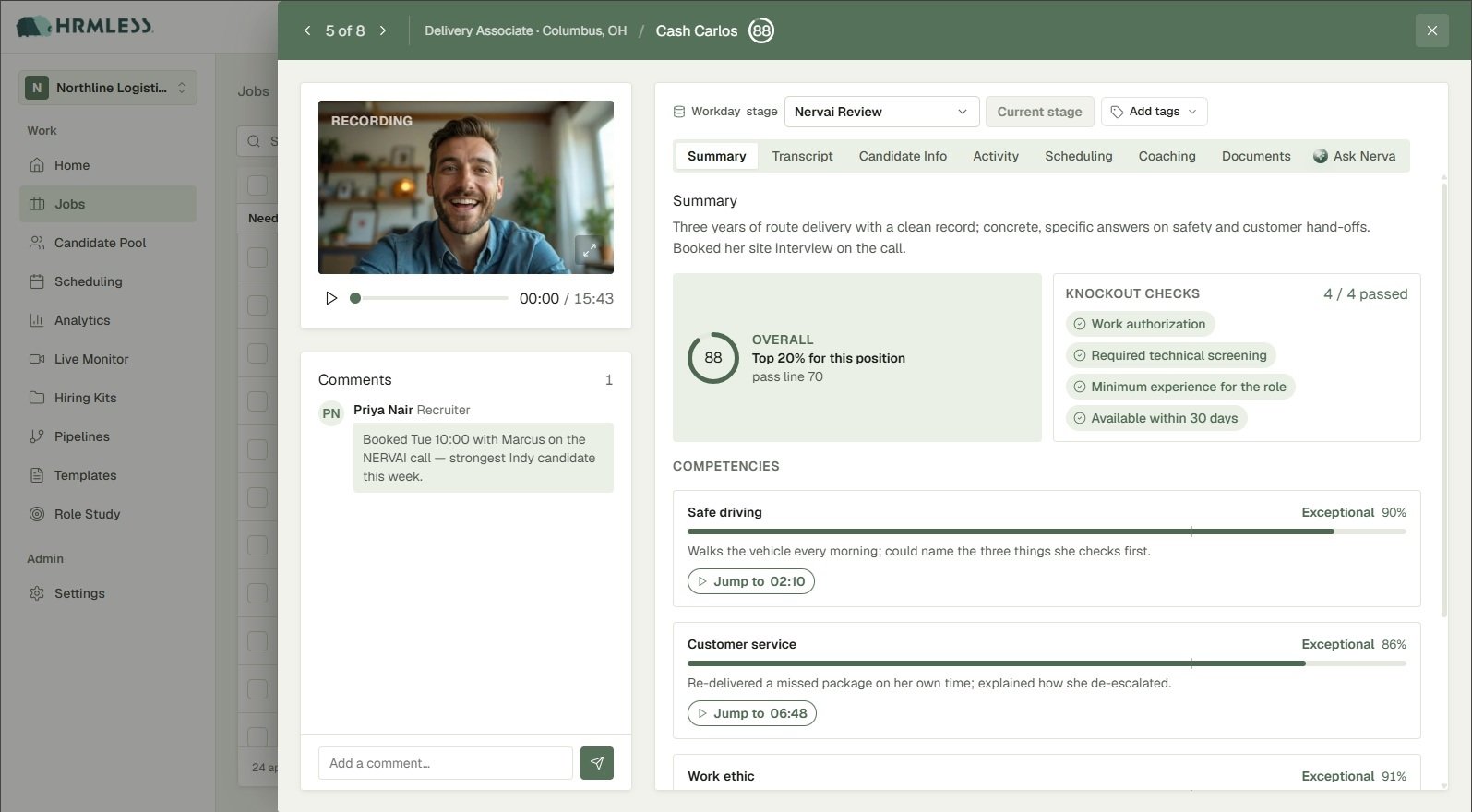
TL;DR: A good AI interview isn't a black box. It's a structured interview: every candidate gets the same job-related questions, answers are scored against a written rubric, and the scorecard shows the evidence behind each score. Structured interviews are among the best predictors of job performance in decades of personnel-selection research. AI makes it possible to run one for every applicant, within minutes, at 2 a.m.
Key takeaways
- In Schmidt and Hunter's 1998 meta-analysis, structured interviews predicted job performance with a validity of about .51, compared with about .38 for unstructured interviews.
- A 2022 re-analysis by Sackett and colleagues ranked structured interviews as the strongest single predictor they studied, at about .42.
- The value comes from structure: consistent questions, behavioral anchors and scoring rules. The AI's job is to apply that consistently at scale.
- Every score should link to the transcript and recording so a person can check it.
The five competencies we see matter most in hourly roles
| Competency |
What it predicts |
Example question |
Strong answer shows |
| Work ethic |
Attendance, finishing shifts |
"Tell me about a time you stayed late or picked up extra work to get a job done." |
A specific situation, the action they took and a concrete result |
| Grit |
Staying through hard first weeks |
"Describe the most physically demanding job you've had. What kept you going?" |
Persistence through difficulty without blaming others |
| Coachability |
Ramp speed, safety compliance |
"Tell me about feedback from a supervisor and what you changed." |
Acceptance of the feedback and a specific behavior change |
| Communication |
Customer and team interactions |
"How would you explain a delay to an upset customer?" |
Clear, calm, solution-focused language |
| Curiosity |
Learning new systems and routes |
"Tell me about something new you learned on your own for work." |
Self-directed learning and applying it |
How a score is built, step by step
- Define the role. The hiring team picks competencies and weights. HRMLESS builds benchmarks from the client's own top performers, not a generic library.
- Write the rubric. Each competency gets behavioral anchors describing weak, adequate and strong answers.
- Ask and follow up. The AI asks one question at a time and follows up when an answer is vague ("What did you do next?"), just as a trained interviewer would.
- Score against anchors. Each answer is scored on the job-related content of what was said, not on accent, appearance or facial expressions. That's true whether the candidate takes the interview by voice or on video.
- Combine and threshold. Competency scores are weighted into an overall score. The employer sets the pass threshold.
- Show the evidence. The scorecard links each score to the exact transcript passage and recording.
- Human decision. Recruiters and managers review and decide.
How to audit AI interview scores
- Spot-check: each month, have a recruiter blind-score 20 transcripts and compare with the AI's scores.
- Adverse impact: compare pass rates across demographic groups using the four-fifths rule. HRMLESS monitors this continuously and maintains an independent NYC LL144 audit.
- Outcome validation: after 90 days, compare interview scores with retention and performance. If high scorers don't stay longer or perform better, adjust the competencies or weights.
What AI interview scoring should never do
- Score on facial expressions, voice pitch or accent.
- Use protected characteristics or proxies for them, such as zip code.
- Reject a candidate with no human able to see why.
FAQ
Is AI interview scoring accurate?
It's as accurate as the interview design behind it. AI scoring a well-built structured interview consistently tends to beat inconsistent human phone screens. AI scoring vague questions with no rubric doesn't. Validate against your own outcomes.
Does a video interview score differently from a voice interview?
It shouldn't. The same questions and rubric apply, and scoring is based on what the candidate says. Video gives your team more context when they review the recording.
Can candidates game an AI interview?
Behavioral questions with follow-ups are hard to game because they ask for specific past situations. Look for vendors that also flag suspicious patterns, such as reading scripted answers.
Does the AI make the hiring decision?
No. It produces a scorecard with evidence. Your team decides.
Where does the research on structured interviews come from?
Schmidt, F. L., & Hunter, J. E. (1998), "The validity and utility of selection methods in personnel psychology," Psychological Bulletin. Sackett, P. R., Zhang, C., Berry, C. M., & Lievens, F. (2022), "Revisiting meta-analytic estimates of validity in personnel selection," Journal of Applied Psychology.

Written byAnthony TomesHRMLESSAnthony Tomes is the Co-Founder of HRMLESS, an AI-powered hiring platform built on a simple idea: a company’s best people should be the benchmark. HRMLESS evaluates applicants against competency benchmarks developed from an employer’s own top performers—not a generic job description—using AI voice interviews, weighted competency scoring, and human-review safeguards. Anthony built his career in strategic SaaS business development, including several years at ADP working with key accounts and franchise organizations. That experience gave him a firsthand view of the hiring, onboarding, and retention challenges facing high-volume employers. He later founded RouteFlo, an employee onboarding platform designed to help businesses create more consistent and repeatable onboarding experiences. RouteFlo ultimately became part of HRMLESS, bringing together Anthony’s experience in workforce technology with a broader vision for improving how companies identify and hire the right people. Anthony started HRMLESS to help recruiting teams move beyond résumés, keyword matching, and gut instinct. His focus is helping employers hire for demonstrated competency and long-term fit while navigating the rapidly evolving regulatory landscape surrounding AI in hiring. Based in Montana, Anthony writes about AI in hiring, competency-based recruiting, hiring automation, and responsible hiring technology.
Full bio →LinkedIn →How HRMLESS works →