

Why Candidates Prefer an AI Interviewer Over Conventional Human Ones
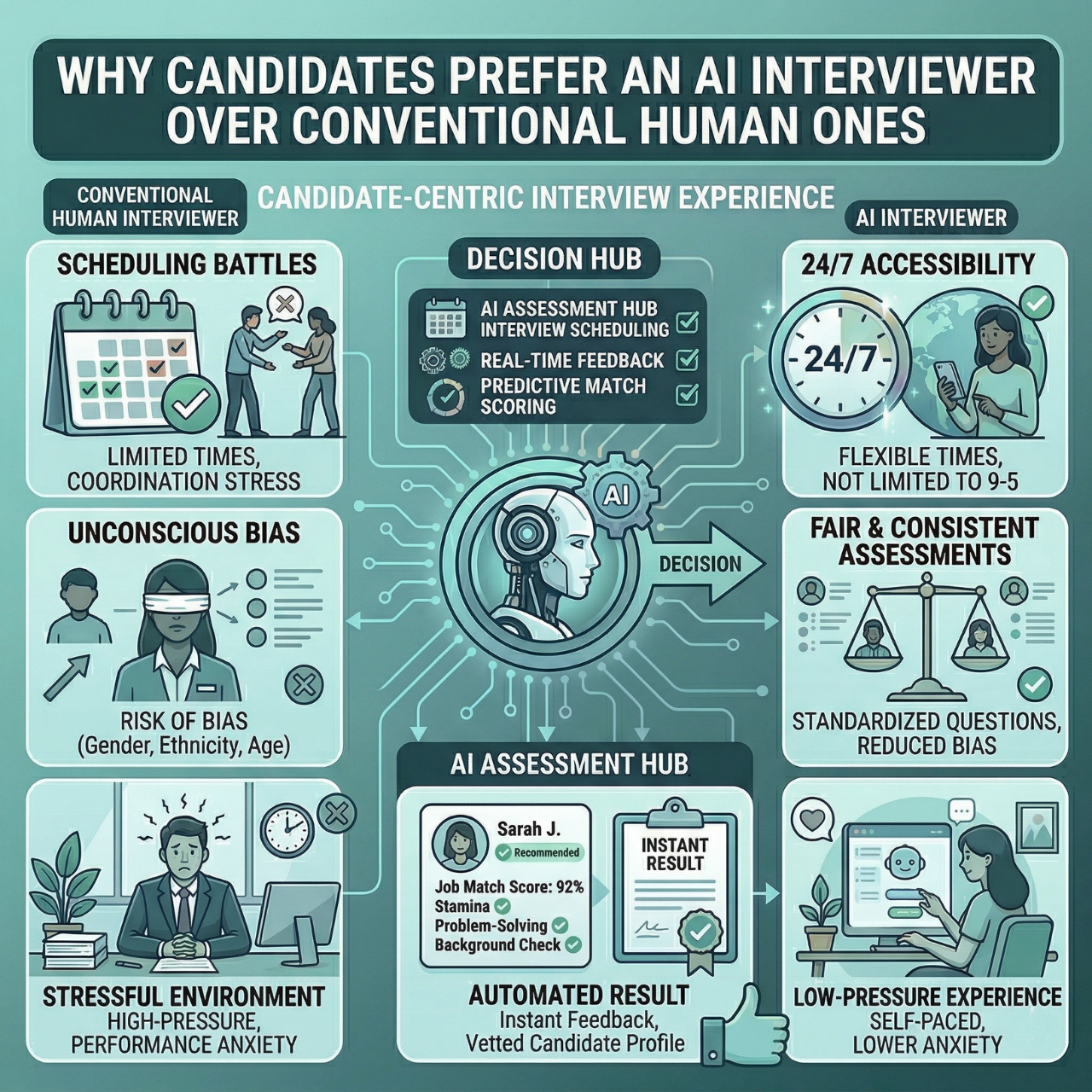
For years, hiring teams have assumed one thing:
Candidates want human interviewers.
Recent research shows the opposite.
Across industries and role types, candidates are increasingly choosing AI interviewers when given the option—and they’re doing so for practical, psychological, and fairness‑related reasons. What many employers view as “cold automation,” candidates often experience as less stressful, more equitable, and far more convenient.
Let’s look at why this shift is happening—and what the data actually says.
Candidates Are Actively Choosing AI Interviews
One of the most compelling data points comes from a large‑scale field experiment conducted by the University of Chicago Booth School of Business, involving approximately 70,000 real job applicants.
When candidates were given a choice between:
- a traditional human‑led interview, or
- an AI‑led interview
78% chose the AI interviewer.
This wasn’t a hypothetical survey. Candidates applied for real jobs, were interviewed under real hiring conditions, and human recruiters still made the final hiring decisions.
The preference for AI wasn’t just emotional—it correlated with better hiring outcomes, including:
- 12% higher job offer rates
- 18% higher job start rates
- 17% higher 30‑day retention [factoryfix.com]
1. Lower Anxiety and Less Social Pressure
One of the most cited reasons candidates prefer AI interviewers is psychological comfort.
In the University of Chicago study, candidates described AI interviews as:
- less awkward
- less intimidating
- more comfortable
Nearly 45% of candidates who interviewed with AI used positive comfort‑related language to describe the experience, compared to just 19% in human‑led interviews.
This aligns with broader research on asynchronous and AI‑mediated interviews, which shows they reduce social evaluation anxiety by removing:
- interviewer reactions
- facial expressions
- perceived judgment in real time
This is especially impactful for:
- introverted candidates
- neurodivergent candidates
- non‑native speakers
- high performers with interview anxiety
2. Perceived Fairness and Reduced Bias
Another major driver of candidate preference is fairness.
Candidates consistently report that AI interviewers feel more:
- objective
- consistent
- unbiased
In the Chicago Booth study, reported gender bias was nearly cut in half in AI‑led interviews compared to human ones (3.30% vs. 5.98%).
Academic research supports this perception. A 2025 study published in Humanities and Social Sciences Communications (Nature) found that perceived procedural justice (how fair and transparent the process feels) strongly influences candidates’ acceptance of AI interviews, particularly in high‑volume and technology‑forward contexts. [nature.com]
Candidates are not assuming AI is perfect—but they often trust it more than fatigued, rushed, or inconsistent humans.
3. Convenience and Control Over Timing
Traditional interviews require:
- schedule coordination
- availability during business hours
- real‑time interaction
AI interviewers remove these constraints.
Candidates can:
- interview immediately after applying
- complete interviews nights or weekends
- avoid phone tag entirely
Research on asynchronous video interviewing consistently shows flexibility and autonomy are major predictors of positive candidate reaction, especially for hourly, shift‑based, and high‑volume roles.
For candidates juggling:
- work
- caregiving
- multiple applications
AI interviews simply fit better into real life.
4. Consistency Beats “Personality Judgment”
Human interviews are influenced by:
- interviewer fatigue
- mood
- implicit bias
- conversational drift
AI interviewers don’t:
- forget questions
- skip key topics
- rush because of time pressure
Analysis from the Chicago Booth experiment found AI interviews covered significantly more required topics than human interviews, resulting in:
- more structured responses
- clearer evaluation for recruiters
For candidates, this means:
- being evaluated on substance
- not charisma or small talk
- not “vibes”
High‑performing candidates often prefer structure over improvisation—and AI delivers exactly that.
5. AI Interviews Still Keep Humans in Control
Importantly, most modern AI interview systems:
- do not make final hiring decisions
- support, not replace, human judgment
Candidates understand this.
Industry analysis from Forbes and IBM emphasizes that AI interviews improve candidate experience when used for early‑stage screening, allowing humans to focus on final decision‑making and relationship building. [forbes.com], [ibm.com]
Candidates don’t reject human involvement—they reject unnecessary friction.
Addressing the Skepticism (And the Research Nuance)
Not all studies show universal preference for AI interviews in every context.
Some research has found:
- candidates in low‑tech industries may be more cautious
- unclear evaluation criteria can reduce comfort
- poor AI design harms trust
The takeaway isn’t that all AI interviews are equal—it’s that well‑designed, transparent AI interviewers outperform outdated manual workflows.
Final Thoughts: Candidates Are Voting With Their Time
Candidates don’t prefer AI interviewers because they dislike humans.
They prefer them because:
- they feel fairer
- they reduce anxiety
- they respect schedules
- they eliminate delays
And crucially, they work.
When nearly 8 out of 10 candidates choose AI interviews, and those candidates exhibit better retention and job performance, the message is clear:
this isn’t a trend—it’s a structural shift.
Hiring processes optimized for candidates are no longer optional.
They’re expected.
Featured

Subscribe to ournewsletter
Related posts
Explore the world of photography with our curated selection of
portfolio websites that showcase creativity and innovation.